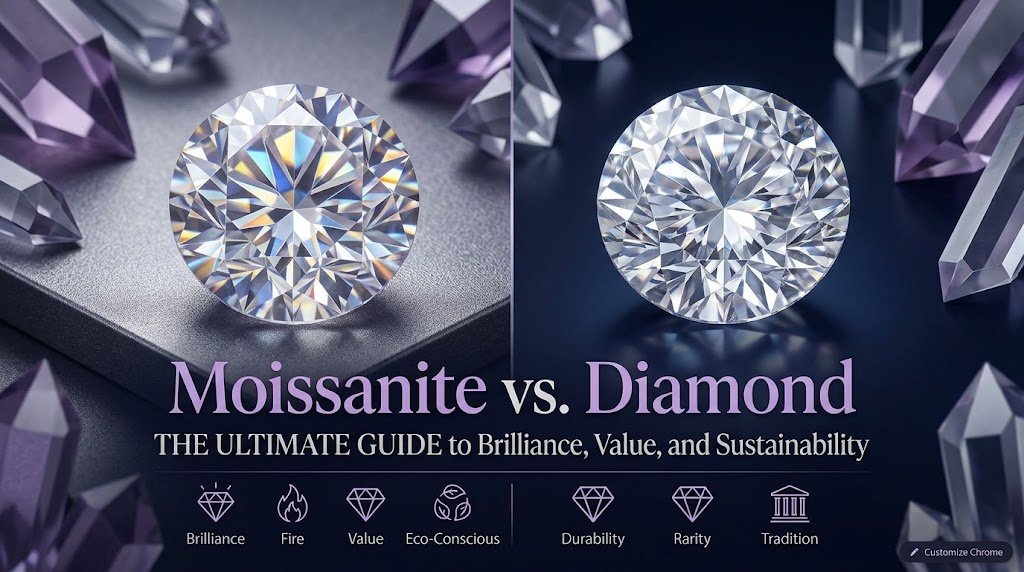
When shopping for an engagement ring or fine jewelry, understanding moissanite vs diamond is essential. Both gemstones offer beautiful sparkle, but they differ in brilliance, durability, price, and sustainability. This guide will help you decide which is right for you.
Affiliate Disclosure Statement:
This site contains affiliate links to products. We may receive a commission for purchases made through these links at no extra cost to you.
Moissanite vs Diamond: Key Differences Explained
Diamonds have long been associated with engagement rings, romance, and luxury. But moissanite has become an increasingly popular alternative for shoppers who want exceptional sparkle, impressive durability, and a beautiful look without paying traditional diamond prices.
If you’re exploring beautiful jewelry alternatives, discover our guide to stunning moissanite bracelets for more inspiration.
At first glance, moissanite vs diamond can be a difficult comparison because the two gemstones look remarkably similar.
So which one is right for you?
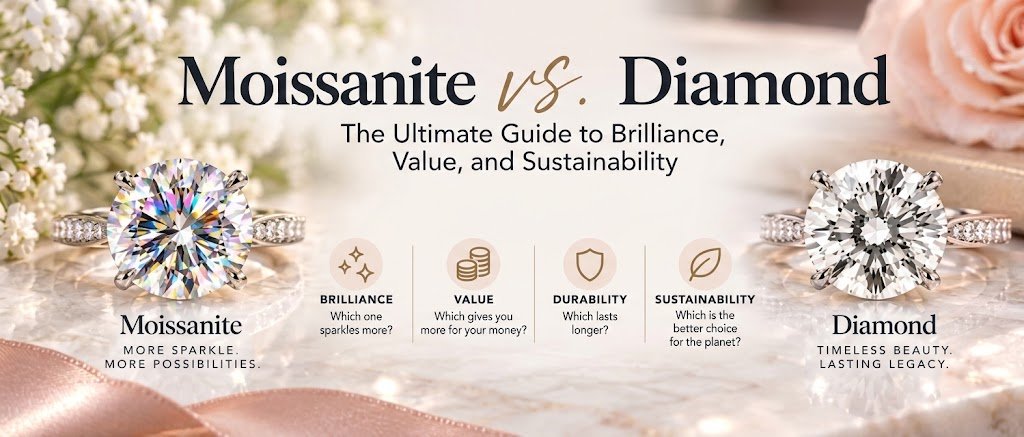
This guide compares moissanite vs. diamond to help you decide which gemstone best fits your style, priorities, and budget.
What Is Moissanite?
Moissanite is a gemstone made from silicon carbide.
Natural moissanite is extremely rare, so virtually all moissanite used in jewelry today is created in controlled laboratory environments. This allows jewelers to produce beautiful, consistent stones without relying on conventional gemstone mining for the center stone.
Moissanite is especially popular for engagement rings because of its intense brilliance and durability.
Its biggest attraction?
Sparkle—lots of it.
Moissanite has a higher refractive index than diamond, which contributes to its distinctive brilliance. It also produces colorful flashes of light known as fire, particularly under bright lighting.
For someone who loves a brilliant, eye-catching engagement ring, moissanite can be an excellent choice.
Browse our full collection of Moissanite Engagement Rings to find your perfect match.
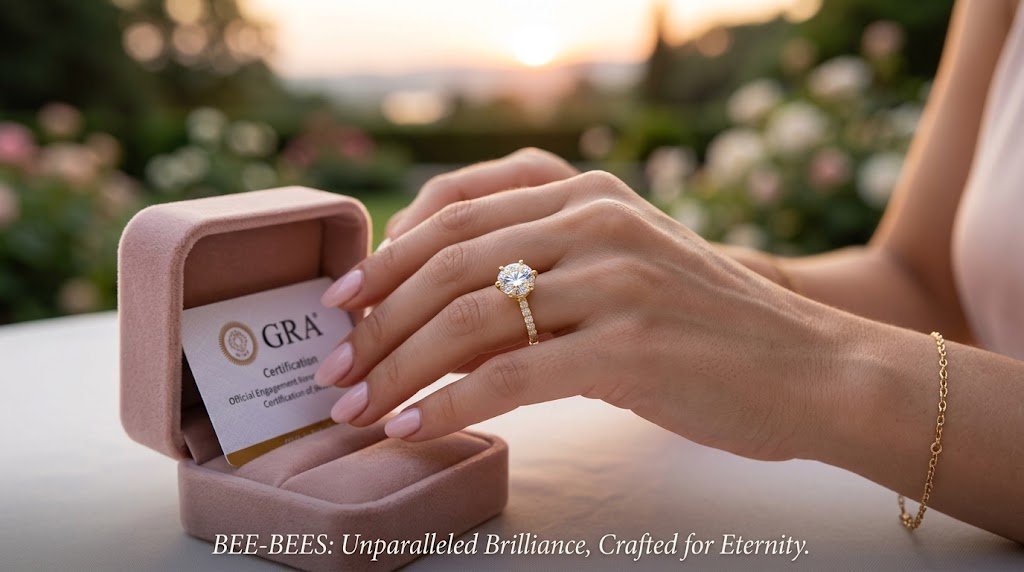
Shop the 1.5ct Moissanite Engagement Ring – s925 Sterling Silver – GRA
What Is a Diamond?
Diamond is a crystalline form of carbon and has been used in jewelry for centuries.
Natural diamonds form deep within the Earth under extreme heat and pressure over extraordinarily long periods of time. Today, shoppers can choose between natural diamonds and lab-grown diamonds.
Diamonds are famous for their hardness, classic appearance, and cultural association with engagement rings.
While moissanite tends to display stronger rainbow-like flashes, diamonds generally produce a different balance of white light, fire, and scintillation.
That distinction is one of the easiest ways to understand the visual difference between the two gemstones.
Moissanite vs Diamond: Comparison at a Glance
| Feature | Moissanite | Diamond |
|---|---|---|
| Composition | Silicon carbide | Carbon |
| Mohs Hardness | Approx. 9.25 | 10 |
| Brilliance | Exceptionally high | High |
| Fire | Strong, colorful flashes | More restrained |
| Price | Generally much more affordable | Generally more expensive |
| Availability | Primarily lab-created | Natural or lab-grown |
| Everyday Wear | Excellent | Excellent |
| Traditional Prestige | Growing | Established |
| Best For | Maximum sparkle and value | Tradition and diamond identity |
Both gemstones can be beautiful choices. The better option depends on what matters most to you.
1. Moissanite vs Diamond Brilliance: Which Stone Sparkles More?
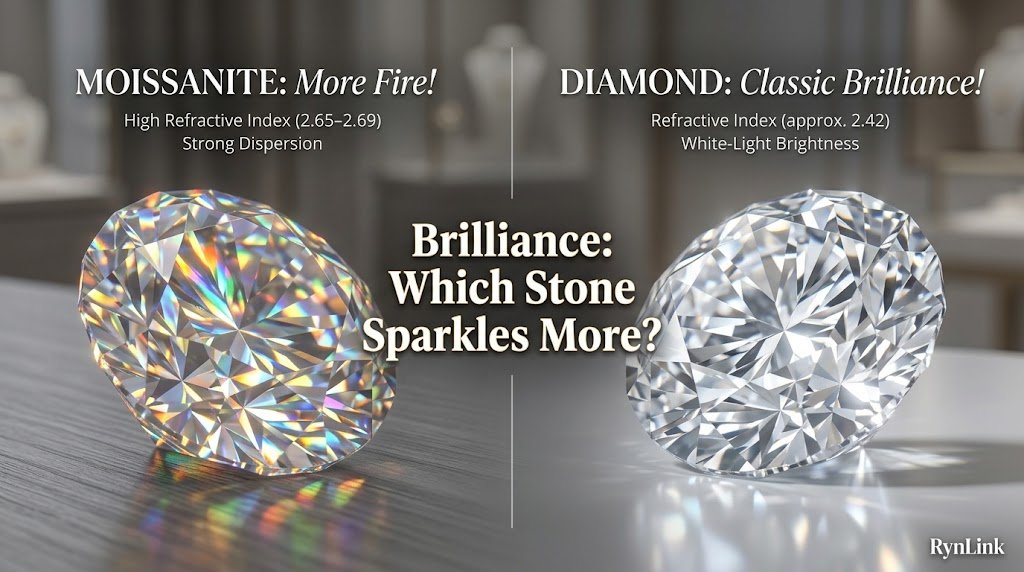
This is where moissanite really stands out.
Moissanite
Moissanite has an exceptionally high refractive index, approximately 2.65–2.69.
Because of this, it can return a tremendous amount of light to the eye. Moissanite also has strong dispersion, which creates noticeable flashes of rainbow-colored light.
Under sunlight, spotlights, or evening lighting, a well-cut moissanite can look spectacular.
Diamond
Diamond has a refractive index of approximately 2.42.
Diamonds are also highly brilliant, but their light performance has a somewhat different character. A well-cut diamond typically combines white-light brightness, colored fire, and scintillation.
The Winner for Maximum Sparkle: Moissanite
If your goal is a gemstone that produces bold brilliance and noticeable rainbow fire, moissanite has the advantage.
If you prefer the classic optical appearance traditionally associated with diamonds, diamond may appeal to you more.
2. Moissanite vs Diamond Price Comparison: How Much Can You Save?
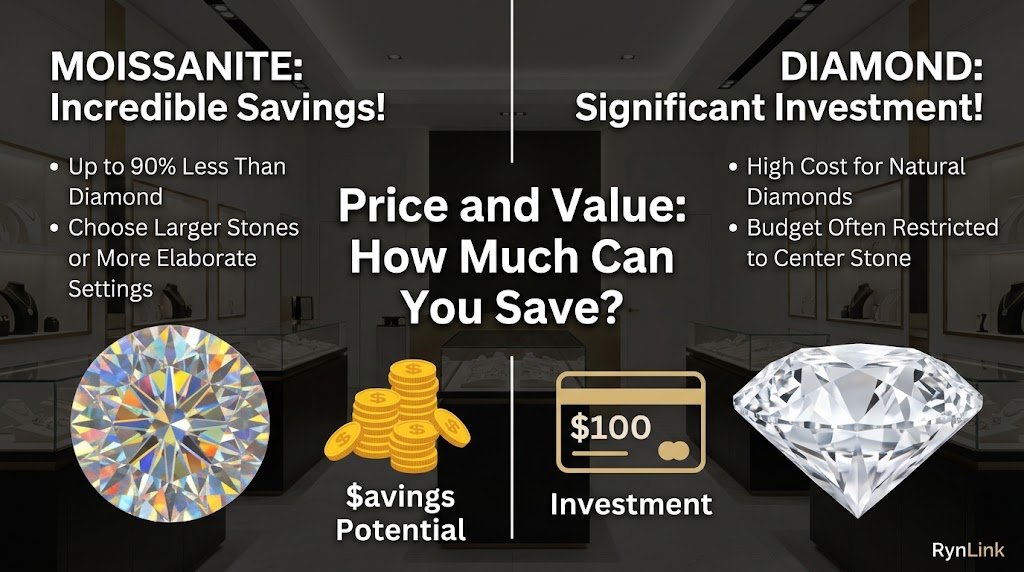
For many shoppers, this is one of the biggest differences between moissanite and diamond.
High-quality diamonds—especially larger natural diamonds—can become expensive very quickly.
Moissanite generally allows you to choose a larger-looking center stone or more elaborate setting for significantly less money than a comparable natural diamond ring.
That means your budget can go toward the design you actually want instead of being concentrated almost entirely in the center stone.
For example, you may be able to choose:
A larger center stone
A halo setting
An eternity-style band
Additional accent stones
A more detailed ring design
The Winner for Value: Moissanite
For shoppers who prioritize beauty, size, brilliance, and affordability, moissanite offers compelling value.
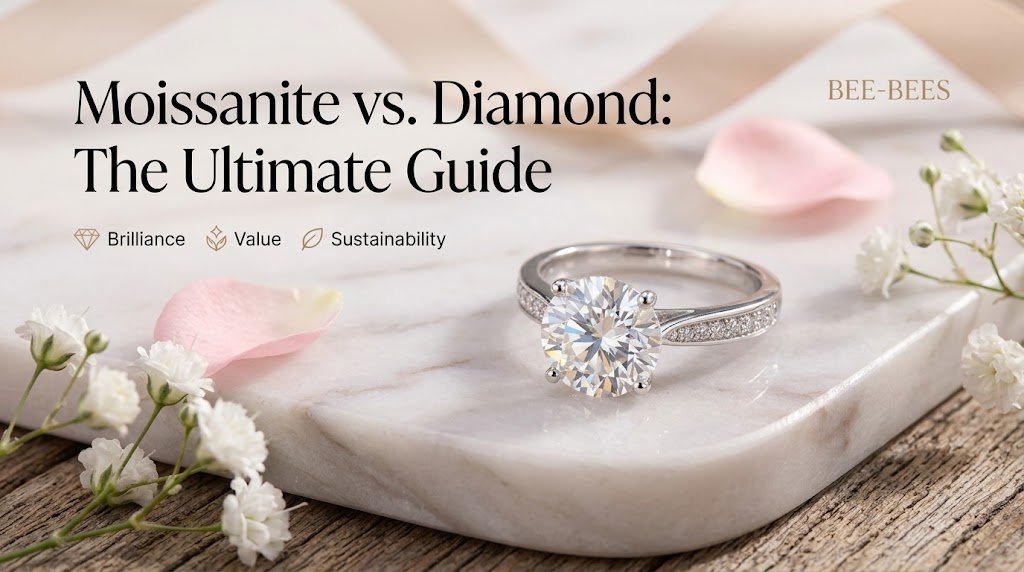
Shop: Round Moissanite Solitaire Engagement Ring | D VVS1 S925 Silver & GRA
3. Moissanite vs Diamond Durability: Which Lasts Longer?
An engagement ring needs to do more than look beautiful.
It has to withstand years of everyday wear.
The Mohs scale measures a mineral’s resistance to scratching.
Diamond: 10
Moissanite: approximately 9.25
Diamond is the hardest known natural mineral and sits at the top of the Mohs scale.
But moissanite is also extremely hard.
With a rating around 9.25, it is well suited to jewelry that may be worn regularly, including engagement rings.
Both gemstones can therefore be excellent options for everyday jewelry when properly set and cared for.
Winner: Diamond
Diamond wins on absolute hardness, but moissanite remains an exceptionally durable choice for everyday wear.
4. Appearance: Can You Tell Moissanite From Diamond?
Sometimes—but it isn’t always obvious at a casual glance.
High-quality colorless moissanite can appear very similar to diamond, especially when viewed from a normal distance.
The biggest visual clue is often the gemstone’s fire.
Moissanite tends to produce stronger rainbow flashes, while diamonds generally display a different combination of white brilliance and colored fire.
The difference may become more noticeable as stone size increases.
That doesn’t make one prettier than the other.
It simply means they have different optical personalities.
Choose Moissanite If:
You love dramatic sparkle, rainbow fire, and an eye-catching look.
Choose Diamond If:
You prefer traditional diamond optics and specifically want a diamond.
5. Sustainability: Is Moissanite a More Sustainable Choice?
Sustainability is increasingly important to jewelry shoppers, but this comparison deserves some nuance.
Because jewelry-grade moissanite is generally created in laboratories, its production does not require mining a natural moissanite gemstone from the Earth.
That can reduce some of the land disruption and mining-related concerns associated with conventional gemstone extraction.
However, lab-created does not automatically mean impact-free.
Producing gemstones in a laboratory requires energy and resources, and the environmental footprint can vary depending on the manufacturer, energy source, facility, jewelry metals, supply chain, and transportation.
Natural diamond production also varies significantly between producers and regions.
So rather than claiming that every moissanite ring is automatically “eco-friendly,” it is more accurate to say:
Lab-created moissanite can offer an attractive option for shoppers who want to reduce their reliance on newly mined center stones.
If sustainability is one of your highest priorities, look beyond the gemstone alone. Consider the metal, manufacturing practices, packaging, shipping, sourcing transparency, and expected lifespan of the jewelry.
6. Moissanite vs. Lab-Grown Diamond: What’s the Difference?
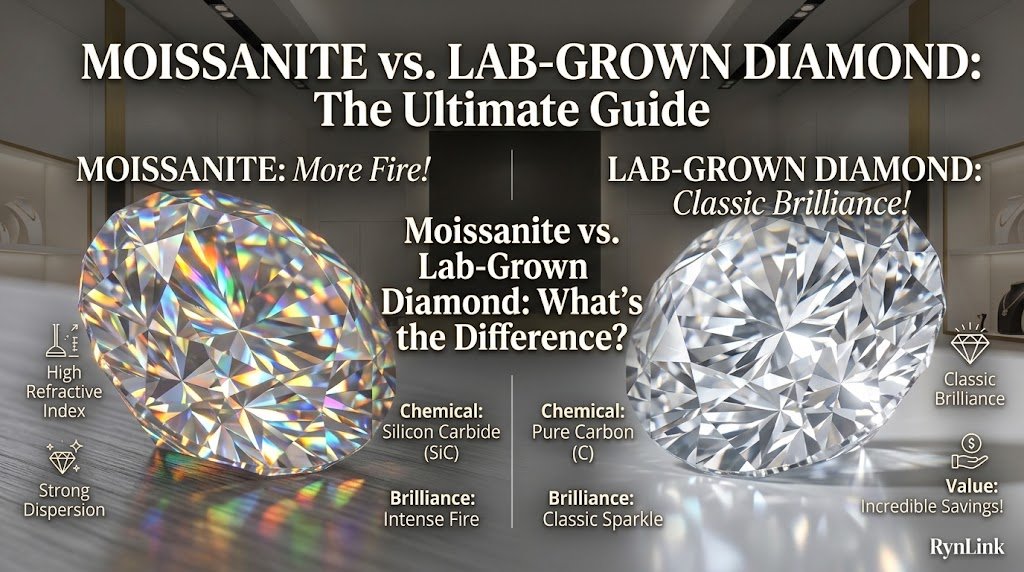
This is an important distinction.
Moissanite is not a lab-grown diamond.
They are completely different gemstones.
Moissanite is silicon carbide.
A lab-grown diamond is carbon with essentially the same crystal structure and fundamental physical characteristics as a mined diamond.
So if you specifically want a diamond but prefer a laboratory-created option, lab-grown diamond may make sense.
If you’re primarily looking for maximum brilliance, durability, and value, moissanite may offer the more attractive combination.
7. Moissanite vs Diamond: Which Looks Bigger?
Moissanite is often sold using measurements in millimeters or diamond-equivalent size descriptions because it has a different density from diamond.
That means comparing stones purely by carat weight can be misleading.
When shopping, pay close attention to the actual dimensions of the stone, particularly its millimeter measurements.
For example, two stones described using similar carat terminology may not have exactly the same dimensions or visual presence.
For online shoppers, millimeter measurements can often provide a clearer picture of how large the stone will actually look on the finger.
8. Does Moissanite Get Cloudy?
Quality moissanite does not inherently become permanently cloudy simply because it gets older.
Like other jewelry, however, oils, lotion, soap residue, cosmetics, and everyday dirt can accumulate on the stone and reduce its sparkle.
Regular cleaning can restore its brilliance.
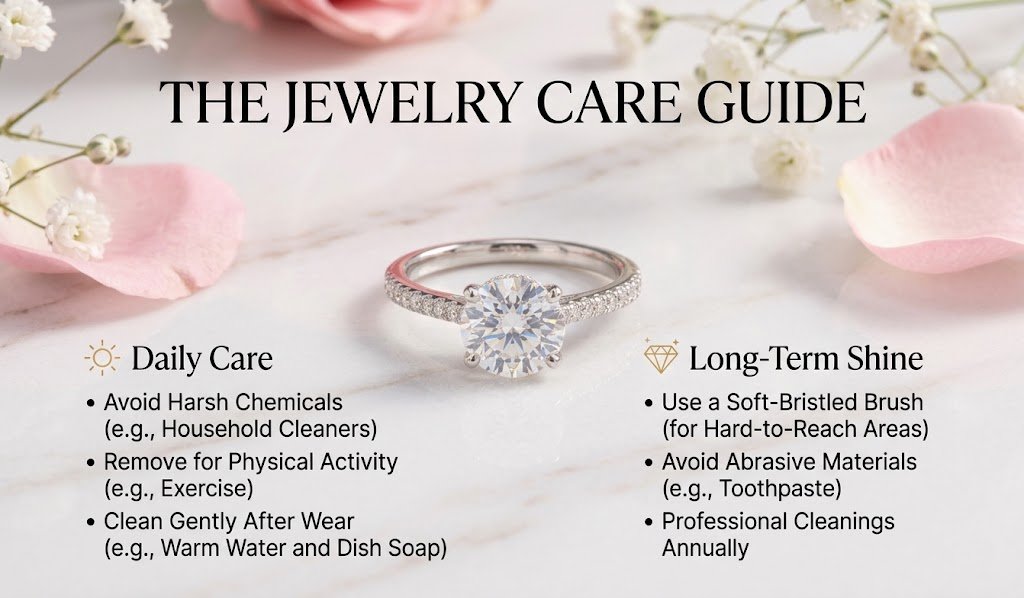
A simple jewelry-care routine can make a major difference.
Use mild soap, warm water, and a soft brush when appropriate for your ring’s setting, and avoid harsh chemicals unless the jewelry manufacturer says they are safe.
For detailed step-by-step cleaning instructions, check out our Jewelry Care Guide.
9. Which Gemstone Is Better for an Engagement Ring?
There isn’t one universal winner.
The best gemstone depends on what you value most.
Choose Moissanite If You Want:
Exceptional brilliance
Strong rainbow fire
Excellent durabilityA larger-looking stone for your budget
More freedom to choose an elaborate setting
A lab-created gemstoneLuxury-inspired beauty without traditional diamond pricing
Choose Diamond If You Want:
The traditional engagement-ring gemstone
Maximum hardness
The distinct optical appearance of diamond
The cultural and symbolic association of a diamond
A natural or lab-grown diamond specifically
Neither choice needs to be viewed as a compromise.
They’re simply different gemstones serving different priorities.
Popular Moissanite Cuts
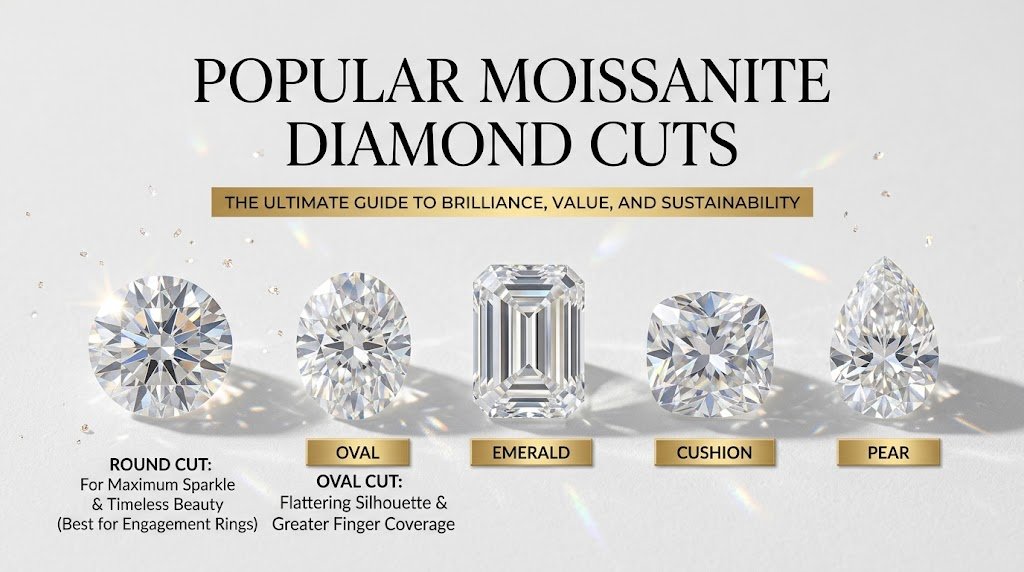
One of the advantages of moissanite is that it looks beautiful in many different cuts.
Round Cut
Round moissanite is ideal for anyone who wants maximum sparkle and a timeless appearance.
Its symmetry works beautifully with moissanite’s natural brilliance.
Best for: Classic engagement rings and maximum sparkle.
Oval Cut
Oval moissanite combines elegance with a flattering elongated silhouette.
Because of its shape, it can also create the appearance of greater finger coverage.
Best for: Romantic, elegant engagement rings.
Emerald Cut
Emerald-cut moissanite has long step-cut facets and a sophisticated geometric appearance.
Rather than emphasizing intense sparkle alone, emerald cuts create a sleek, mirror-like pattern of light.
Best for: Modern and vintage-inspired jewelry.
Cushion Cut
Cushion cuts combine rounded corners with a soft, romantic shape.
Best for: Vintage-inspired engagement rings with plenty of sparkle.
Pear Cut
Pear-shaped moissanite combines characteristics of round and marquise shapes for an elegant teardrop silhouette.
Best for: Distinctive engagement rings and statement jewelry.
Moissanite vs. Diamond: Which Gives You More for Your Money?
If you’re judging purely by traditional rarity and diamond identity, diamond occupies a different category.
But if you’re judging by visual impact per dollar, moissanite is difficult to ignore.
Instead of spending most of your budget on the center stone, moissanite can give you more flexibility.
You may be able to choose the ring style you truly love while keeping money available for your wedding, honeymoon, home, savings, or other priorities.
Luxury doesn’t have to mean choosing the most expensive option.
Sometimes it means choosing intelligently.
Frequently Asked Questions
Is Moissanite a Fake Diamond?
No.
Moissanite is not a fake diamond. It is a separate gemstone with its own chemical composition and optical properties.
It may be used as a diamond alternative, but it should be represented and sold as moissanite.
Does Moissanite Pass a Diamond Tester?
Some traditional thermal diamond testers may react to moissanite because both materials conduct heat efficiently.
Modern multi-testers can use additional properties to help distinguish between moissanite and diamond.
A tester result alone should not be used to misrepresent a moissanite as a diamond.
Can You Wear Moissanite Every Day?
Yes.
With a Mohs hardness around 9.25, moissanite is highly resistant to scratching and is well suited to engagement rings and other jewelry intended for frequent wear.
As with any fine jewelry, the setting should still be inspected periodically for loose stones or damage.
Does Moissanite Lose Its Sparkle?
The gemstone itself doesn’t simply lose its optical properties over time.
However, dirt, skin oils, lotion, and residue can make any gemstone appear less brilliant.
Regular cleaning helps keep moissanite sparkling.
Is Moissanite Good for an Engagement Ring?
For many couples, absolutely.
Moissanite offers an attractive combination of brilliance, durability, affordability, and design flexibility, making it particularly appealing for engagement rings.
Final Verdict: Moissanite or Diamond?
The answer comes down to what matters most to you.
If tradition, diamond identity, and maximum hardness are your priorities, diamond remains an exceptional choice.
But if you’re looking for extraordinary sparkle, impressive durability, larger visual impact, and excellent value, moissanite deserves serious consideration.
It gives couples another way to choose a beautiful engagement ring without feeling pressured to follow outdated spending rules.
Your engagement ring should represent your relationship—not someone else’s expectations.
And whether you choose moissanite or diamond, the most important thing is choosing a ring you will genuinely love wearing.
Discover the Brilliance of Moissanite
Ready to find a ring that combines timeless beauty with extraordinary sparkle?
Explore the Bee-Bees Moissanite Jewelry Collection and discover engagement rings and jewelry designed to deliver brilliant style without the traditional diamond price.